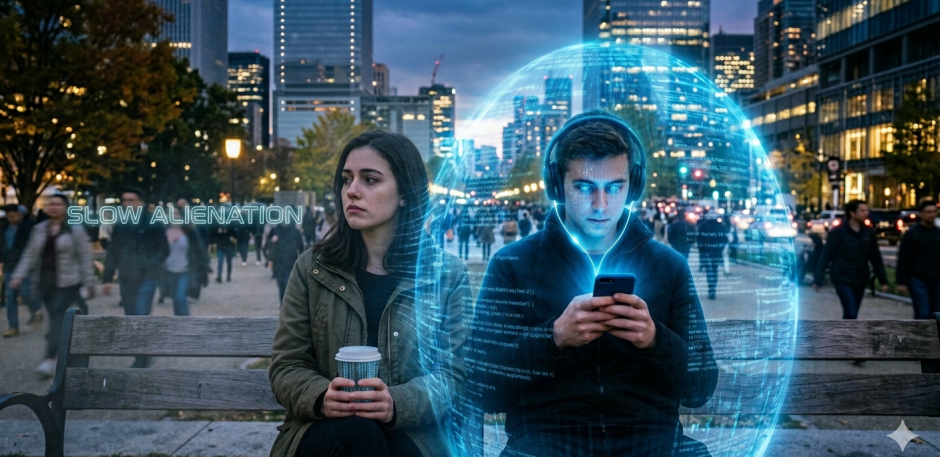
When Modern Comfort Comes at an Unexpected Cost
Cities have never been more advanced.
Smart apartments anticipate our needs. Food arrives within minutes. Entertainment streams endlessly. Remote work allows professionals to build careers without leaving home. Technology has made urban life faster, safer, and more convenient than previous generations could have imagined.
On the surface, modern city living appears to be a remarkable success story.
Yet beneath the convenience and efficiency, a quieter reality is emerging.
Many people are experiencing a form of loneliness that does not look like traditional isolation. They are surrounded by neighbors, coworkers, digital connections, and crowded public spaces, yet they feel emotionally detached from the world around them.
This condition can be described as quiet isolation—a subtle but powerful sense of disconnection hidden beneath a comfortable lifestyle.
And its effects may be reshaping the emotional health of modern cities in ways we are only beginning to understand.
What Is Quiet Isolation?
Quiet isolation differs from obvious loneliness.
A person experiencing traditional isolation may have very little social contact and clearly recognize their situation.
Quiet isolation is more difficult to detect.
People may have:
- Stable careers
- Comfortable homes
- Active social media accounts
- Regular online communication
- Busy daily schedules
Yet despite appearing socially connected, they often feel disconnected emotionally.
The problem is not necessarily the absence of interaction.
It is the absence of meaningful connection.
This subtle distinction explains why many people struggle to identify the source of their dissatisfaction despite living seemingly successful lives.
The Rise of Comfortable Loneliness
Modern urban life increasingly prioritizes convenience.
Almost every daily activity can now occur without significant human interaction.
Consider how much has changed:
- Food delivery replaces neighborhood restaurants.
- Online shopping replaces local stores.
- Streaming services replace public entertainment venues.
- Remote work replaces office communities.
- Digital communication replaces face-to-face conversations.
Each innovation saves time and reduces effort.
Collectively, however, they remove many of the everyday encounters that once connected people to their communities.
As comfort increases, opportunities for spontaneous human interaction often decrease.
The result is a lifestyle that feels efficient but emotionally incomplete.
Why Cities Feel More Lonely Than Ever
Cities are designed to bring people together.
Millions of individuals share the same streets, transportation systems, workplaces, and public spaces.
Ironically, many urban residents report feeling increasingly isolated.
This contradiction occurs because proximity does not automatically create connection.
Living near people is not the same as knowing them.
Modern urban environments often encourage anonymity. Residents move frequently. Work schedules are demanding. Digital devices compete for attention. Many interactions become brief, transactional, and superficial.
People may encounter hundreds of individuals every day while developing very few meaningful relationships.
This creates an environment where loneliness can thrive even in the middle of a crowd.
The Erosion of Community
Historically, cities depended on strong local communities.
Neighborhood cafés, public parks, local markets, religious institutions, and community organizations served as gathering places where relationships developed naturally.
Many of these social structures still exist, but their influence has weakened.
Increasingly, people spend their free time in private spaces rather than public ones.
Entertainment happens at home.
Shopping happens online.
Communication happens through screens.
As participation in community life declines, the emotional infrastructure of cities begins to weaken.
The city remains physically connected but socially fragmented.
The Psychological Impact on the Urban Soul
Human beings are social creatures.
We do not simply need information, services, and convenience. We also need belonging, recognition, and meaningful relationships.
When those needs are not met, the effects can be profound.
Quiet isolation is often associated with:
- Increased stress
- Emotional exhaustion
- Anxiety
- Depression
- Reduced life satisfaction
- Feelings of emptiness
- Loss of community identity
The challenge is that these symptoms often develop gradually.
People adapt to increasingly isolated lifestyles without realizing what they have lost.
Over time, comfort can mask a deeper emotional void.
Technology: Connecting Devices, Separating People?
Technology is not the enemy.
Digital tools have improved communication, productivity, education, and access to services in extraordinary ways.
The problem emerges when technology becomes a substitute for human connection rather than a tool that supports it.
A message can replace a conversation.
A video call can replace a visit.
A social media update can replace meaningful engagement.
These substitutions are often efficient, but efficiency is not always emotionally satisfying.
Technology excels at transmitting information.
Human relationships require presence, vulnerability, and shared experiences.
The two are not always interchangeable.
Why Comfort Alone Cannot Sustain Happiness
Modern society often measures success through comfort and convenience.
Larger homes, smarter devices, faster services, and greater efficiency are viewed as signs of progress.
Yet human fulfillment has always depended on more than material comfort.
People need:
- Friendship
- Purpose
- Belonging
- Shared experiences
- Community involvement
Without these elements, even highly comfortable lifestyles can feel empty.
The urban soul is nourished not only by what we consume but by how we connect with others.
This is why many individuals who appear successful from the outside still struggle with feelings of loneliness and emotional dissatisfaction.
Rebuilding Human Connection in Modern Cities
The solution is not rejecting technology or abandoning urban living.
Instead, it involves intentionally rebuilding opportunities for meaningful connection.
Practical strategies include:
- Spending more time in community spaces
- Participating in local events
- Supporting neighborhood businesses
- Limiting passive screen time
- Prioritizing face-to-face conversations
- Joining clubs, volunteer groups, or community organizations
- Building stronger relationships with neighbors
Small interactions often lead to deeper connections over time.
The goal is not simply to be around people but to engage with them.
The Future of Urban Well-Being
As cities continue to evolve, policymakers, planners, and residents face an important challenge.
Future urban success should not be measured solely by technological advancement or economic growth.
It should also be measured by the strength of human relationships.
The healthiest cities will be those that balance innovation with community, efficiency with belonging, and convenience with connection.
Because ultimately, thriving cities are not built only with infrastructure.
They are built with relationships.